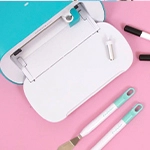
We're going to explain some techniques, tips, and all the materials you need for colouring stamps in a simple way. Undoubtedly, colouring stamps give a different touch to your projects and can be something very entertaining, almost therapeutic.
4 Different techniques for colouring your stamps
However, to get the wanted result, you have to follow some guidelines and tips because it's not the same to paint a stamp with Distress as to paint it with Copics or paint it with watercolours or pencils. How many times has the ink blurred when you colour a stamp?
If you want information about stamping inks, their uses, and materials, we recommend you check the ink characteristics in this table.
Markers
One of the quickest and easiest options is to paint with markers. There are many types of markers, but we love to work with Copics or Chameleon.
Copics are high-quality permanent markers with two tips, a beveled tip and a brush tip for quick sketching. They are ideal for creating shadows and gradients on our designs. They are famous for being a favourite of manga illustrators, the quality is great!
Chameleon is a magic marker because with just one marker you can create gradients of up to 10 different shades or intensities thanks to the mixing cap where you insert the tip for a few seconds.
When painting, the colour degrades from the lightest to the darkest shade.
Tips:
- If you want to paint with alcohol-based markers, it is very important to choose resistant ink, one of the best is Memento.
- When using Copic markers, it is best to use three shades following the same numerical order. Use the darkest of them for the edges to create a depth effect.
- To use Chameleon, remember that markers should be neither too flat nor too straight if you want to achieve a good gradient. To get a uniform colour, the key is to paint in a zig-zag pattern. Remember to store these markers horizontally so that the ink doesn't get stuck on just one of the tips. You will find more information in this post.
- As these markers are alcohol-based, you must choose a suitable paper to paint with them: neither very thin paper, like a sheet of paper, nor watercolour paper, which is usually rough. Caballo paper is the most suitable for colouring with markers.

Watercolour pencils or watercolours
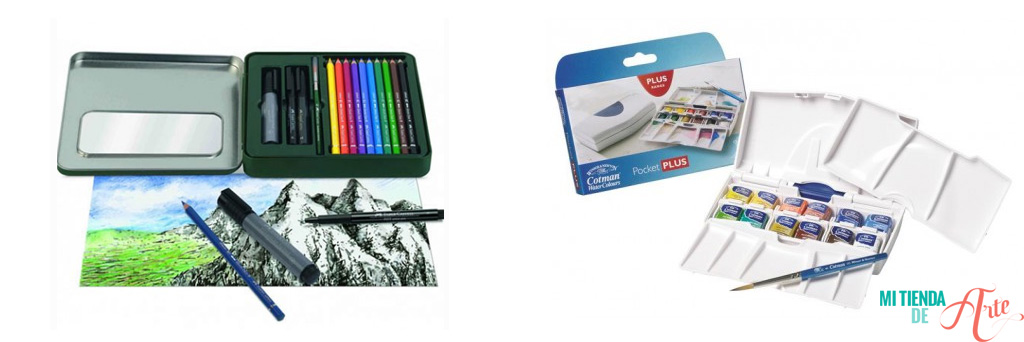
It's a fun option to create all kinds of effects. All you need is a little practice to get the wanted results You can use watercolour pencils from different brands such as Faber Castell or Bruynzeel Sakura or traditional watercolours (both in tablet and liquid format).
Tips:- To paint with watercolours or watercolour pencil, you need waterproof ink, like Archival or Versafine.
- You can work with a brush or a water tank brush. Obviously, the latter option is the most practical, and you have more control over the water flow.
- They need watercolour paper to absorb the water without spoiling the work.
- Always keep some towel paper at hand to catch any excess.
- Once you have painted your stamp, you can apply some heat with a heat gun to set the colour.
Colouring with Distress
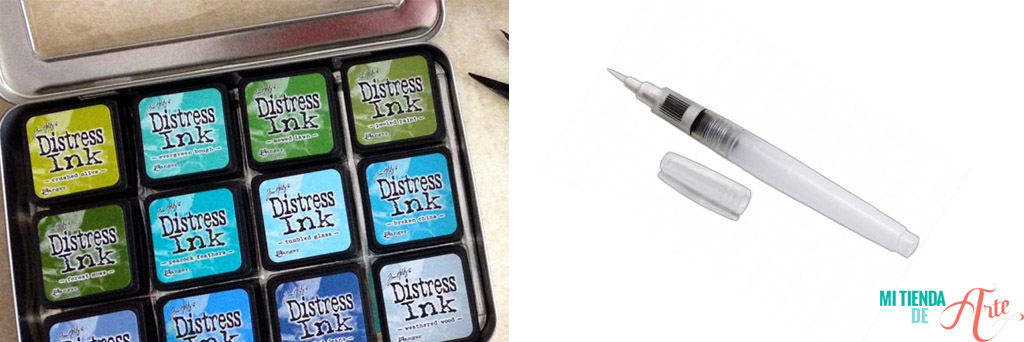
Another great option is to colour with Distress inks. Sometimes we forget we can use them for more than just stamping.
If you use Distress inks for colouring, we recommend having a methacrylate stamping block or a glass or silicone cutting base at hand. Rub the Distress pad on it and spray a little water to help you mix the colours with a brush.
Tips:- The best ink to stamp something that will be coloured with Distress Inks is a waterproof ink: you can use Archival, Stazon, or Versafine.
- If you want to create shadows and depth on your stamp, use two inks of the same colour but in different shades.
- Remember that the most suitable paper is a thick paper, preferably watercolour paper, as you will be working with water, and it needs the ink and water to be well absorbed.
Colouring with gelatos
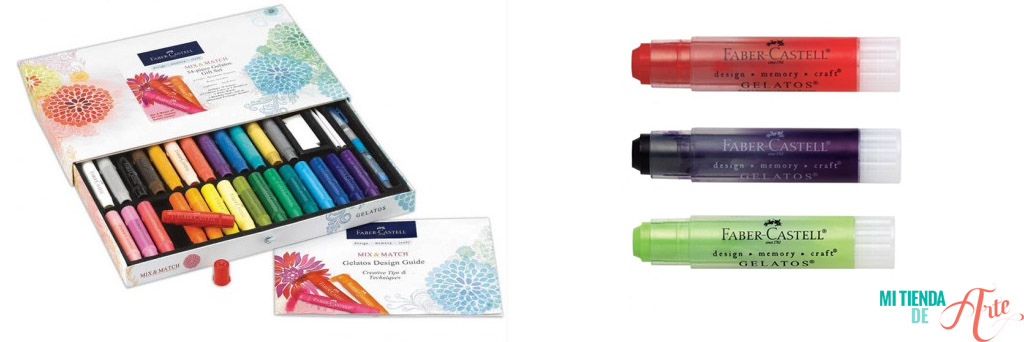
Our latest suggestion is gelatos, those compact, permanent pigment sticks that glide on smoothly and creamily and react like watercolours when you add some water. They are quite versatile as they can be used with a lot of materials.
Tips: - To colour stamps, do not paint directly with the gelato, but with a brush. Gelatos have a very thick tip that makes it a little difficult to pain on small areas.
- To create shadows and depth effects, work with two different but complementary colours of gelato.
- Use the embossing dryer to remove the final humidity.
- And, as in all those examples where water is involved in the process, use watercolour paper.