You've probably used markers countless times and you think of them as simple office supplies or as tools for crafts and school projects. You're about to discover a new artistic technique that will surprise you. The Copic Ciao markers will make you want to start painting with markers.
Markers are a Japanese invention from the early 1960s. Its appearance is linked to Japanese calligraphy, which used brushes and ink for its strokes. Markers were born as a tool that was capable of modernizing and making these brushes more practical and functional, making writing an easier task.

Over time, they've become very popular all over the world. Their use is common in the school environment, although they've also found their place in the professional world and now, the use of markers is considered as one of the new artistic techniques when talking about illustration, comic (especially manga), and design.
There are different types of markers available on the market, and we can differentiate two large groups:
- Water-based markers: dilutable ink in water. This group of markers includes the common markers, the ones we usually have around the house, although there are professional water-based markers that have a watercolour finish. The best-known range of water-based markers for scrapbooking are Tim Holtz's Distress Crayons.
- Alcohol-based markers: Professional markers are included in this group. This kind of markers allow overlapping work without mixing colours, which is very useful.
Among all the available brands, in this post we'll focus on Copic, the professional marker range from the Japanese company Too Corporation. They commercialize four models of high quality markers under the Copic brand: Copic Original (the classic), Copic Sketch (the most extended and the one with the widest range of colours), Copic Wide (with a wider tip designed to use in large surfaces) and finally, Copic Ciao (the most economical line of Copic).
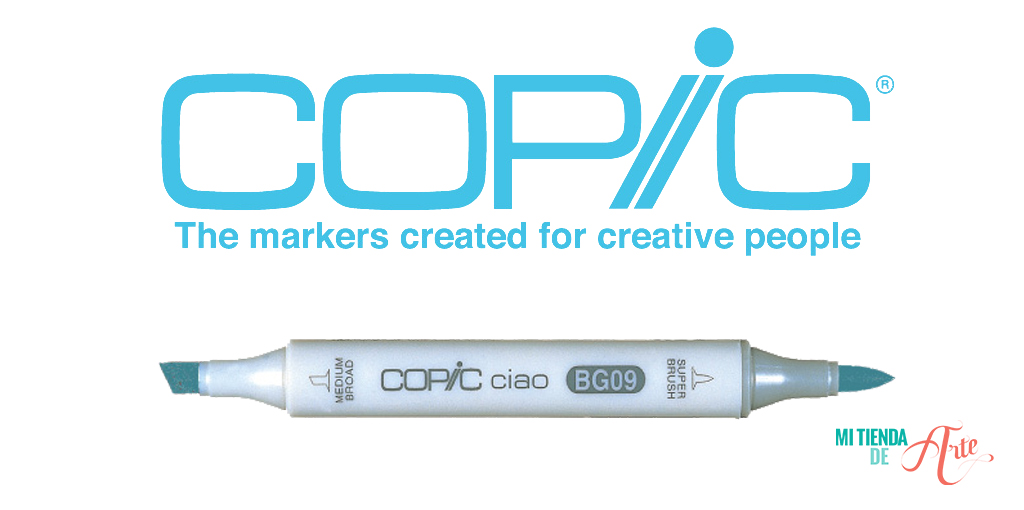
As we've said before, these are high-end markers for professional use, which usually means they have a high price. That's why Copic offers you the Copic Ciao line, its most economical line of markers. Whether you want to get started in this technique and use them for sketching or colouring, or if you're looking for a quality bonus for your crafts, such as scrapbooking or printing projects, they're the best available choice.
Just because they're more affordable than other markers, that doesn't mean their quality is compromised: they're alcohol-based, non-toxic, quick-drying, permanent and acid-free markers. Their pigments allow the mixing of colours to achieve gradations. The pen body has a capacity of 2.5 ml. of ink which, once used up, is refillable.
Each Copic Ciao has two tips, a bevelled tip for filling in or applying to larger surfaces and a brush tip that allow us to be more precise with our strokers, which is ideal for quick sketches or fine lines.
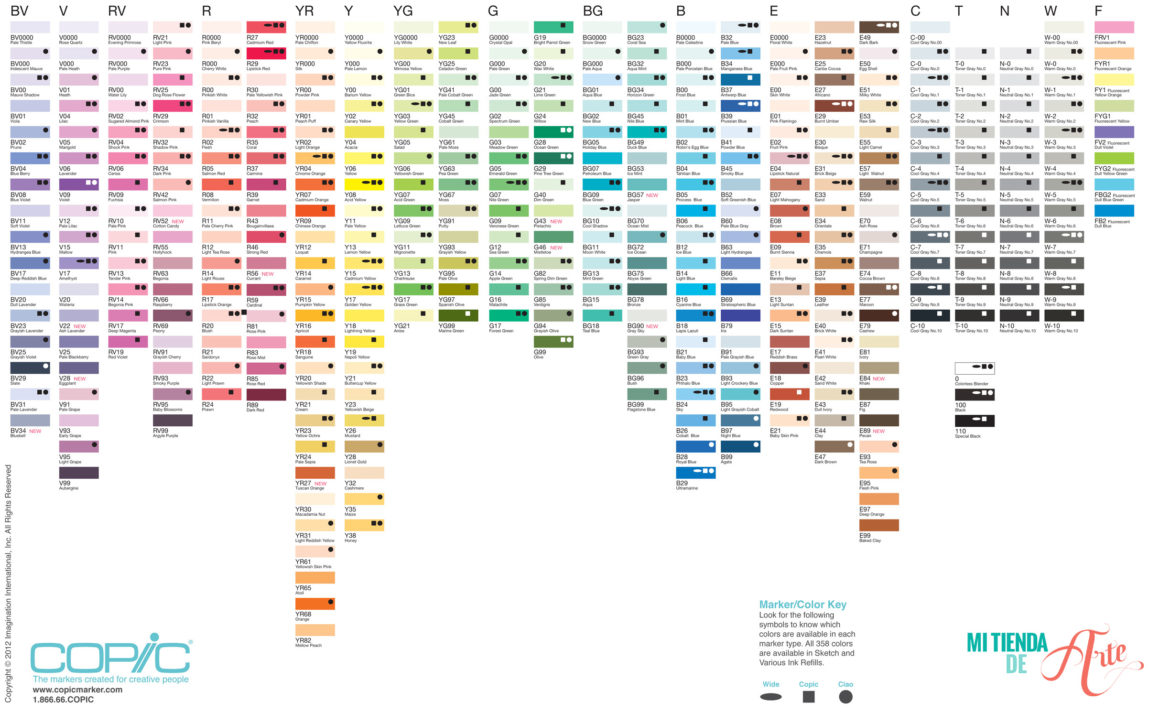
How does Copic Ciao differ from other Copic Markers? The difference between the Japanese brand's pen lines lies, among other things, lie in the millilitre capacity of the pen body; in the variety of shapes for the tips, with nine different types of refills available so far for Copic Original, for example; and in the range of colours available in each case, which can be more or less extensive depending on the Copic line we're talking about (for example, Copic Sketch has a total of 358 different colours).

The only thing that doesn't change is the ink. This enables a common colour coding for all different lines of markers. Each pen has an alphanumeric combination inscribed on the base of the cap or body that helps to identify and differentiate each colour accurately.
If we look at these numbers, they all begin with one or two letters that indicate the type or colour (Y for yellow, G for green, and so on). Next, there is a two-digit number: the first one indicates the saturation of that colour and can range from 0 to 9. Between 0 and 3 are lights, colours with values between 4 and 6 are intermediate or transitional colours and those with saturation values between 7 and 9 correspond to shadows. The second digit that appears, is the lightness value, being 0 the lightest and 9 the darkest value. Finally, in the lower part, we find the name that receives the colour (Acid Yellow, Pure Pink, Chrome Orange etc.)

A good understanding of how colour coding works will be very useful for making colour blends or gradients, in order to find those shades that fit and complement each other the best.
This is a table where the 358 colours of Copic are represented. The legend at the bottom of the table informs us graphically, and through geometric figures, what colours are available for each model of markers.
This whole range of colours will help us in our scrap work, especially when colouring stamps. Use a quick release ink to stamp your image (like Versafine or Memento), and colour it in with Copic markers! Start with the lighter shade and gradually add more intensity. Use the number "0" or "blender", to blend the colors and integrate them easily.
As you can see, markers are much more than children's paints. They are complex creative tools that are more versatile than what most people assume. From Craftelier we may have tempted you, haven't we?
We encourage you to discover this technique with the Japanese markers Copic Ciao, synonymous with quality and ideal for beginners. Take a look at our colourful cases, special sets for scrapbooking and printing - choose the one that suits you best and tell us your impressions!