Let's see Tim Holtz's Distress Oxide features, applications, and techniques to know the difference between them and the traditional ones. These inks offer new creative horizons for our scrapbooking and Mixed Media projects.
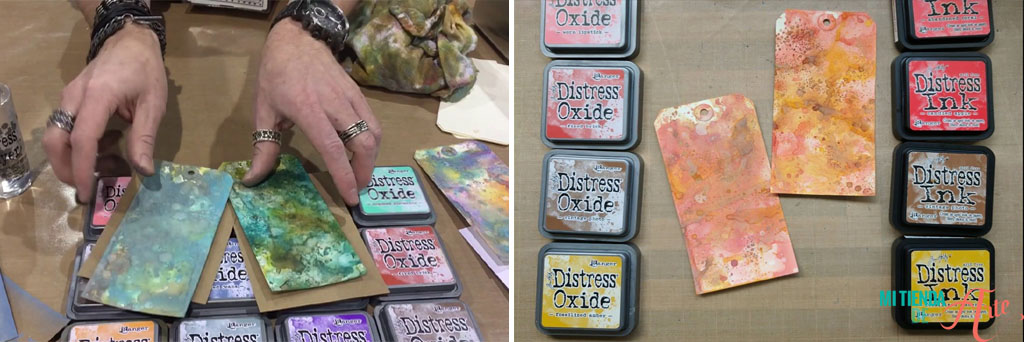
Surely, you have used the Distress Inks before and for you to get a better idea, we could introduce them as an evolution of the first ones.
The Distress Oxide has a special ink composition that allows the finish to be totally different from the Distress Ink. In fact, in the left photo, you can see the differences between the samples made with Distress Oxide (the left tag) versus Distress Ink (right tag). As you can see, the colours of the Distress Oxide blend and integrate much better and the final result is different, totally matte.
But what does this special ink composition consist of? It is something completely new and revolutionary that has come out of the creative mind of Mr. Tim Holtz. If you know anything about scrapbooking inks and their composition, you may have noticed that most inks are either dye-based (dye ink) or pigment-based (pigment ink). But Oxide Inks are made up of pigments and dye, allowing you to work with them in many and different ways.

Characteristics of Distress Oxide:
- They react to water. As we said, they are made up of a combination of dye and pigment, so, when you apply water, these two components split, creating incredible effects with a rusty look. The more water you apply, the more the components separate and the more the image blurs. If you want sharp results, apply very little water.
This type of effect is very much in line with Tim Holtz's designs. If you like vintage and steampunk style, you have to try it!
- They are opaque, unlike Distress Ink, which are translucent. This is perfect to work easily on dark surfaces and backgrounds. This feature is achieved thanks to their pigment-based composition, but they maintain the properties of the dye inks, a great combination! Distress Inks are not the best inks for stamping, but you will notice a great improvement with Oxide Inks.
You can even use them to paint directly with a brush and colour your stamps. The colour gets brighter and becomes more radiant.
Moreover, as they are opaque, you can work on layers and layers of colour, one on top of the other, although you have to work after the previous layer has dried. You can mix them again without any problem if you moisten them.
- The texture of these inks is chalky, rusty, and somewhat scratchy.
Techniques with Distress Oxide:
There are different ways of working with Distress Oxide depending on your tastes and needs. Here are some examples, although we are sure you will find many others and adapt them completely to your personal projects.
You can create backgrounds in the same way as you did with Distress Ink, but this time getting a matte effect.
You can apply them with an Ink Blending Tool or by directly painting on a plastic-coated surface, adding water, and rubbing the paper over the surface.
With the help of an Embossing Heat Gun, you can remove the humidity from the inks and dry them, this way it is much easier to overlap colours.

If you use a stamp to apply the colour, you will have much more control over the background you are creating.
Another much simpler option is to apply the colour directly from the colour pad and then blend it with some water.
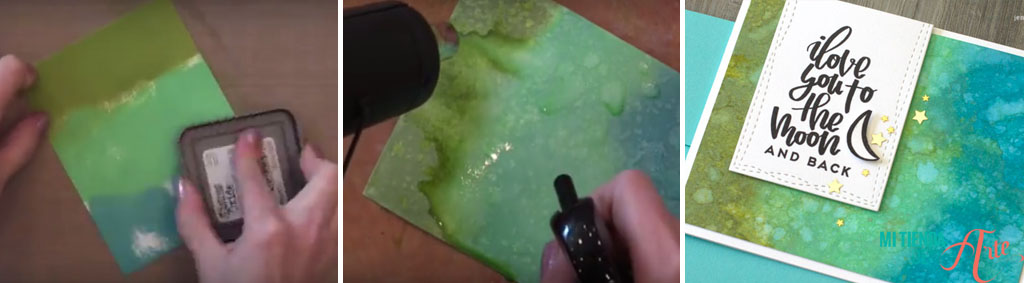
You can also use them with a brush as if they were watercolours! Use a plastic surface as a palette and paint directly with a brush.
You can also use them with stencils, using just a Foam Applicator. As with the classic Distress Inks, you can easily mix and blend different colours.
We strongly recommend you to try them, as we said, on dark backgrounds (black or kraft paper). The results are amazing, wetting the print with water gives it a slightly shiny effect.

@justinehovey / @ebldesigns / www.jennifermcguireink.com
They are available in the same shades that the Distress Ink, and they came in similar packaging to those. But to differentiate them, the Distress Oxide box is slightly silver and not black. Anyway, don't worry, once you open the lid you can see the difference in the felt pad itself, the Oxide pads are much more matte and dense.
If you want to know even more about Distress Oxide, you can watch these video, where you can learn several techniques and tips that will help you to get the most out of these inks:
As you can see, Distress Oxide pads offer a lot of possibilities for our projects. You will certainly do wonders with our dear friend Tim's new inks.