Let's start from the beginning, we need to know what it's exactly.
Calligraphy is an ancient technique or discipline that consists of writing letters paying attention to the way, direction, sequence, and speed at which we trace their features. This technique dates back to Ancient China, where it was considered one of the great arts, at the same level of painting.

If we get very technical, we can say that calligraphy consists of making each significant part of a letter outlined with a single stroke in an unstudied process and without corrections. Besides, it's a handmade process delivered with instruments such as brushes, pens, or markers.
There are different types of calligraphy-based on different typographies, all based on alphabets from different periods such as Roman, Greek, Gothic... However, nowadays, the most common typeface for calligraphy is the Copperplate or English italics. Depending on the type of alphabet we decide to write, we'll need different materials to get better results, but don't worry, if you're still unsure about what kind of calligraphy you'd like to make, you can get a basic kit that will serve you for any type of letter.

Gothic Calligraphy: @wandernib / Spencerian Calligraphy: @mimimicalligraphy
Confusing lettering and calligraphy is quite common, although now we'll see that there are more differences than similarities. The type of typography used in both has no similarities, although lettering often imitates calligraphy. In calligraphy, the same alphabet is always used for the whole text, a broken rule in lettering. But the biggest difference between both techniques is that while calligraphy is a writing process, lettering is a drawing technique, it's a process that we have to think, and that allows us to correct our strokes, to colour our words or modify anything we're not completely satisfied with.
Lettering: @theflowerjournal / Caligrafía: @mimimicalligraphy
What instruments do I need to do calligraphy?
Calligraphy can be done with different instruments, nibs or markers, although we mustn't forget other materials, that are essential especially if we're just starting out: a ruler, a pencil and a rubber. Nowadays, there is a wide variety of products to choose from.
Nibs
It's the most fragile element of all the materials we'll need to make calligraphy. They're those small metallic pieces that we immerse in the ink to soak in pigment to write then over the paper. The first thing we need to know is that in addition to the nib we'll need a nib holder. Nibs are removable and small, so it is essential to have a handle to which they can be attached. We can choose between a straight or an oblique handle, our choice will depend on our activities.
@thewritetime_crafts / @artysia.studio
We can find a lot of different models of nibs, squared, rounded, with different thicknesses, rigid or flexible. If we want to get a standard nib that is suitable for everything, the best thing is a round nib. For Copperplate calligraphy, our recommendation is to purchase an oblique handle and a flexible nib, such as the Gillot 303. TIP: Pay close attention to the position in which you place the quill (there's only one correct position!) and how you place your hands, you should do it as in the image above, so as not to touch the wet ink and smudge our project.
Markers
Writing with a quill can indeed be a bit difficult (although it's all a matter of practice, you get the hang of it quickly!), and that's why there are other instruments to make the task a bit easier. We're talking about calligraphy markers, which are available with many different tips. We recommend the Tombow Fundesnuke, ideal for calligraphy. These markers are water-based, so we can mix them with other liquid inks to achieve more tones and thus expand our range of colours. In addition, their hard tip allows us to play with the thickness of the line; if we do not press, we get a very fine line, if we press, we get a thick line. This versatile marker can also be used for techniques such as lettering or sketching. There is another branch of calligraphy, which is more similar to lettering, the Brush Script or Brush Calligraphy, and is a little more creative. This calligraphy is done with a brush tip pen, so a good option would be the Ecoline Brush Pen or the Pentel Brush Pen.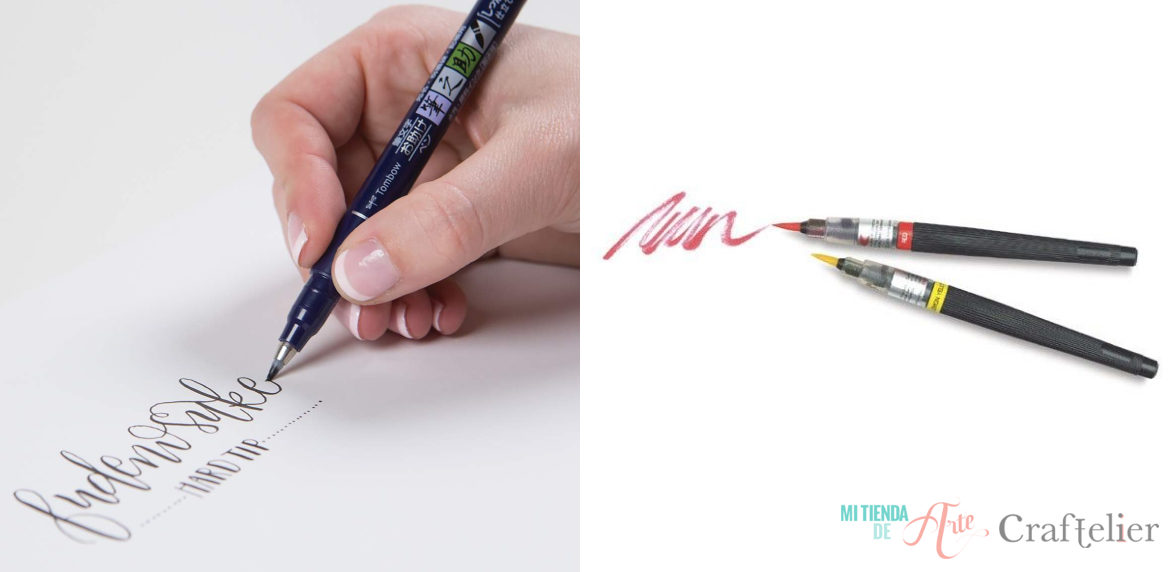
Paper
Choosing a good paper can be very difficult because of the many options we have in the market. However, making a good choice is essential to get good results (and no, an old notebook is no good at all). Calligraphy paper should be smooth and made of cotton, and if possible, soft to the touch so that it's much easier to slide the pen or marker on its surface. In addition, the weight of the paper should be high enough so that the liquid ink does not branch out or transfer to the other side of the paper. To make your search a little easier, we've made a small selection of papers perfect for calligraphy: one of them is the Bloc XL Bristol by Canson, with satin white sheets and very smooth, very resistant and available in two sizes. The Rhodia brand markets perfect pads for calligraphy and, besides, you can choose between their plain sheets or their doted sheets, which are of great help when we are starting, as the dots serve as guides.
Which are the best inks for calligraphy?
The world of inks is even wider than that the nibs or paper ones, there are many types of inks, with different consistencies, colours, and brands. To begin with, and if you're not used to liquid inks, it's best to start with black liquid ink. Depending on the colour, the consistency varies (because of the pigments used), and black ink is the easiest to work with. A good option is Winsor & Newton's black ink, which has a glossy finish that you'll love. Other inks worth mentioning are Winsor & Newton's Calligraphy Ink, used by professionals and really easy to use even for beginners. Finetec inks, in solid format (you'll need to add water to them), stand out for their metallic colours, so if you're looking for these kind shades, these inks are one of the best options on the market. Finally, we can't talk about inks and not mention Dr. Ph. Martin's, we have a post talking about them, you can read it here. If you liked this post about calligraphy and you want us to expand the information based on other aspects of calligraphy or types of calligraphy such as Copperplate, Roman or Gothic, leave it in the comments and we will take note :)
Meanwhile, until the next post!