After the recent interest in calligraphy and lettering, today we clear up some doubts about the Kuretake markers. Specifically, in this post, we tell you all about the Clean Color markers. Many of you have asked us about Tombow, Fudenosuke, Clean Color, and all kinds of lettering pens. Which ones to use, which ones are better?
As usual, there are all kinds of opinions on the subject and, for this reason, we want to explain what differentiates these markers so that you can decide which ones interest you the most.
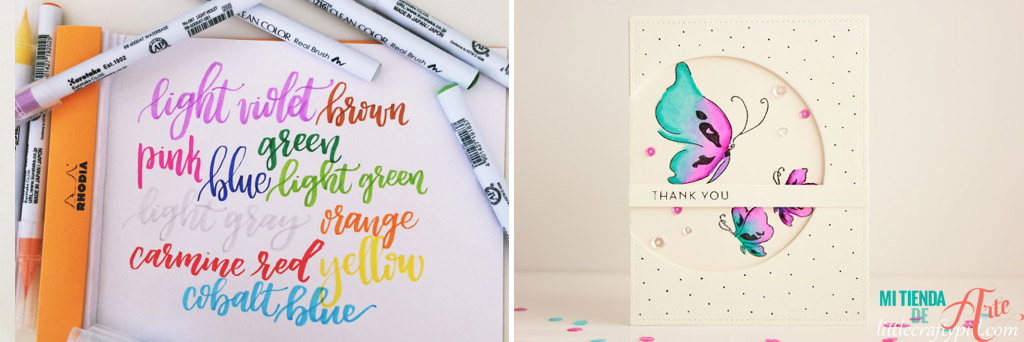
lyssarts.com / www.littlecraftypill.com
Tombow pens are usually the most used pens for calligraphy and lettering because of their double tip (one fine and the other brush type) and because they are watercolour pens. However, the Clean Color is also positioning itself as a pen with great performance, which is why it bears the signature of the prestigious Kuretake!
Clean Color markers have a single brush tip that allows you to make very flexible strokes by simply varying the pressure of the brush. In addition, they are perfect for gradients and colour blends. So what's the big difference between Tombow and Clean Color? The answer lies in the type of material used in the brush tip of both, so don't panic! Let's see what are they made of and how this affects the stroke.
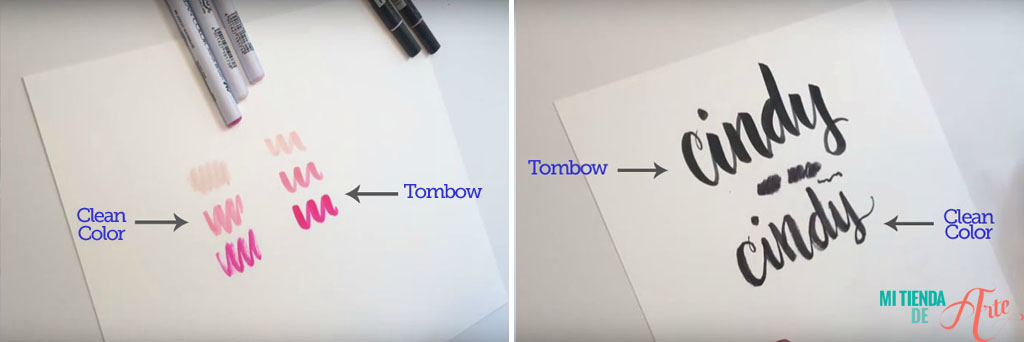
Tombow has a brush tip made of compact felt. The Clean Color tip imitates the bristles of a brush. This results in a different stroke. While the line of the Tombow ABT is more defined, compact, and solid, the line of the Clean Color is more like the typical brush texture, leaving more or less ink depending on the size of the letters and the pressure you exert. So to speak, with the Tombow ABT the result is more perfect and precise and the Clean Color, in large letters, is more imperfect and irregular as if we were drawing or writing with a brush.
The Clean Color markers are watercolour and is ideal for working with calligraphy, lettering, colouring stamps, or including in our Mixed Media projects, either to create backgrounds or to paint details.

lyssarts.com / @teallyletters / honeybeelane.wordpress.com / doodlebugswa.blogspot.com.es
If you want to make gradients or mix colours, there are different techniques to use with the Tombow ABT. In the case of the Clean Color Pens, there are also different ways to work with them without using a blender or mixer.

The first technique would be to mix the ink of one pen directly with the ink of the other. By placing the Clean Colour markers horizontally, we place one tip on top of the other so that the ink passes from one to the other. As you write or draw, the colours will blend together and finally change to the colour of the last marker.
After a short period of use, the added colour will be removed and the pen will return to its original state. If not, you can help yourself by painting on paper - don't be afraid to mix them and play with the gradients!